CLOC 2026 Legislative Agenda

Who We Are
The Children’s League of Connecticut (CLOC) is made up of twelve nonprofit social service agencies that meet the diverse needs of children and families throughout Connecticut. We work together to identify the most pressing issues to advocate with our state funders, commonly Department of Children and Families (DCF) and the Court Support Services Division (CSSD), as well as with state legislators and OPM. This document provides the three (3) most critical issues challenging the success of our programs for children and adolescents needing the highest levels of care and treatment.
Programs We Run
CLOC providers offer all levels of services and programs for children and families including foster care, home based therapies, behavioral health interventions, group homes, respite care, and residential treatment. Our collective footprint spans the state of CT and supports thousands of children and their families.
Did you know?
· The behavioral health system has become the safety net for kids, in the absence of adequate prevention and early intervention programs. We are the “guardrails” that keep children safe, healthy, and hopeful.
· Medicaid rates have not increased in a meaningful way since 2007.
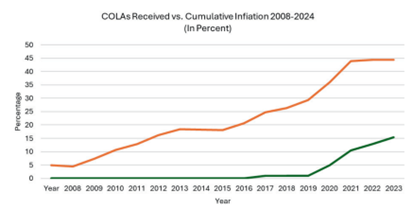
· For decades, state funding increases for our nonprofit children’s service agencies has not kept pace with inflation. According to the CT Nonprofit Alliance, community nonprofits remain 30% behind their true cost of service delivery. We are grateful for recent COLAs and indexing legislation passed for the 2028FY, but we remain far behind rates needed to attract and retain the talented and committed staff that our state’s kids and families deserve.
· As an industry, we face a workforce crisis that prevents us from adequately meeting the needs of the communities we serve.
Critical Issue # 1:
Address the Urgent Needs of Children and Families
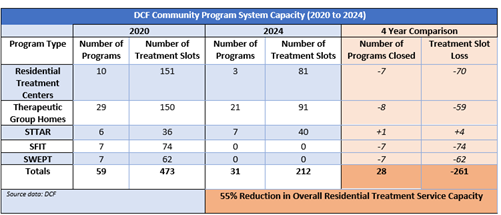
CT has gone too far in reducing congregate care services, limiting access to vital levels of support, especially for children with the most significant needs. Data shows that 261 treatment slots/ beds closed in CT in just 4 years - a 55% reduction. Children and families are not able to access appropriate services in a timely way. Kids end up in programs that are not designed to meet their extensive needs because the remaining providers are full, have wait lists, or the service is no longer provided.
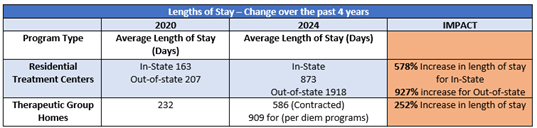
Children aren’t able to access lower or higher levels of care when needed. Youth often remain in a program beyond what is clinically or behaviorally appropriate because there is nowhere else for them to go.
Lack of access to higher levels of care means that children and families are being served at levels that do not address their acuity. This issue is exacerbated by inadequate funding and systematic workforce shortages on the levels of care that precede out-of-home-placements. Children and families in need are often placed on waitlists especially commercially insured youth, often until their needs become so acute that they need a higher level of care.
To avoid continued crisis, we must:
· Stabilize what is currently operating. Fund services appropriately so we can retain staff and keep our doors open.
· Immediately pause the downsizing the therapeutic residential system.
· Redesign models where kids are “stuck,” or develop new models to help facilitate a true continuum of services that allows for access and mobility between levels of care as clinically appropriate for the child.
Critical Issue # 2
Develop a Long-Term plan for the Highest Need Children and Adolescents
We must engage in a comprehensive needs assessment to analyze outcomes, needs, and system gaps, which can guide long-term plan development for CT’s children and families. There are multiple issues with the current system of care, particularly for high-need, high-risk adolescents. Sadly, CT has returned to the practice of sending kids out of state because we do not have appropriate in-state capacity. Related issues/recommendations:
· DCF needs a reliable, centralized system is vital to adequately evaluate needs across the system and plan strategically and collaboratively to meet those needs.
· Prevention and early intervention should be addressed as part of system development.
· In addition to the massive reductions in DCF capacity, CSSD also reduced service capacity for kids most likely to be identified as “often cross-over youth” (youth in both DCF and Juvenile Justice). Many respite care programs, early intervention services, and other services were eliminated. There are no longer enough resources to prevent kids from becoming system-involved. Without proper support their needs are exacerbated and they end up in crisis.
· Too many adolescents have multiple, sometimes a dozen or more, foster care placements, because DCF is opposed to most congregate treatment placements. We agree that, whenever possible, children and adolescents should be in a family, but that is not always possible. It is far worse to have 11 failed foster placements than 1 successful stay in a small, well-run, caring, home-like environment.
· Additionally, there is no capacity left in the foster care network and it is not the solution for all cases. We need to redesign the models where kids are currently “stuck,” or develop new models, because kids are residing in inappropriate placements far beyond what is reasonable or disrupting from placements, increasing trauma and prolonging the opportunity to actually meet their needs.
Critical Issue # 3
Increasing Administrative Burdens
Administrative burden and increasing data requirements are adding expense to agency operations while decreasing clinician time available for direct service.
· Financial and data reporting requirements are increasing at a time when resources need to be focused on service provision. These requirements are not aligned across state agencies, resulting in burdensome and costly data reporting for providers, which often contract with multiple state agencies.
· Revenue retention legislation has been inconsistently applied across state agencies and the requirements lack clarity.
· There is a lack of consistency in data requests and a lack of clarity on the value of those data. As a system, we gladly provide data that guide thoughtful decision-making about service delivery or provides a path towards system improvement. However, providers continue to provide data that are not meaningful or utilized by state agencies.
Critical Issue # 4: Workforce
Recruitment and Retention
The children’s service sector serves the most at risk and in need children and families in Connecticut. Front line workers who support children and adolescents in residential settings deal with the most complex behavioral and mental health challenges daily. The starting pay for direct care staff is between $17 – 21 per hour. We struggle to fill these positions with competent staff, for several reasons:
· Nonprofit human service providers have been significantly underfunded, now 30% behind their 2007 buying power.
· Higher pay at lower stress jobs: Amazon, for example, pays a starting wage of $21/hour to pack boxes. Our staff are literally responsible for the health and wellbeing of children.
· Retention - Staff are leaving positions due to low pay and the uncertainty about future wage increases and growth. We are seeking a long-term solution – indexing our funding to automatically increase annually to cover inflation.
· The sector is still seeing declining numbers of graduates. In 2024, there were just 157 graduates at UConn School of Social Work in a field with hundreds of vacant positions. We are experiencing significant challenges recruiting not just direct care staff but also higher-level positions like clinicians, nurses, teachers in particular.
· Increased openings at the state agencies means that any of our funders are actively recruiting the same candidates that we would hire. The state pays significantly higher, provides a timely COLA every year, and has better benefits.
· If providers can’t fill open positions and/or can’t retain staff, then the number of kids they can serve is reduced. Vacant staff positions mean that we must limit admissions and prolong waiting lists.
Critical Issue # 5
Access to Liability Insurance
There is a shrinking insurance market for nonprofit agencies that provide the most critical services to children and families. Many providers have seen skyrocketing premiums, reduced coverage, and higher deductibles. Some providers, particularly those providing foster care services, have struggled to secure any level of coverage. The costs of coverage in many cases creates budget deficits, causing providers to reconsider provision of these vital services.